
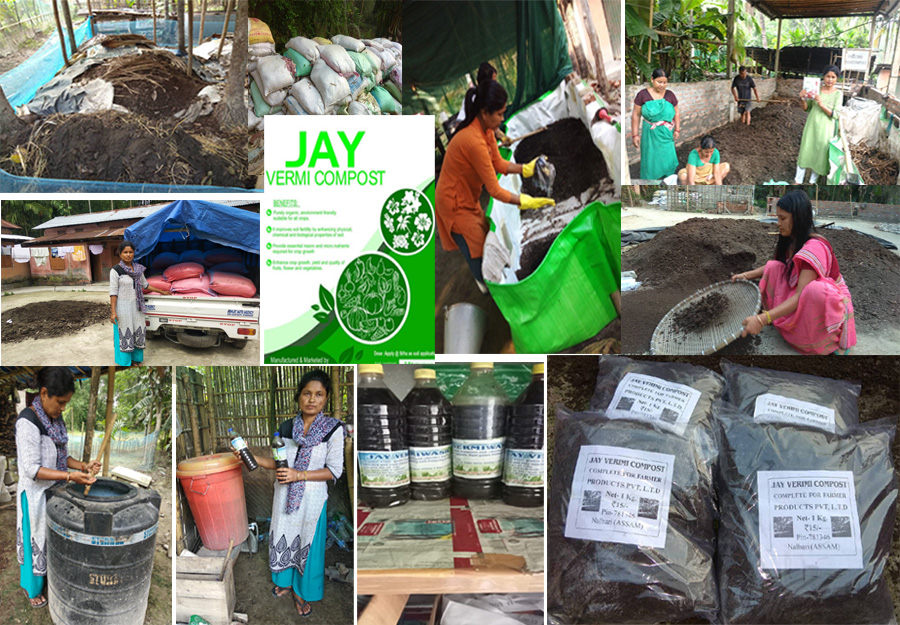
Glimpses of Activities
Journey to Success.
Mrs. Kanika Talukdar, a determined woman from the Titu area of Nalbari district, stands as a living testament to the power of resilience and the transformative potential of entrepreneurship. Her story is not merely one of personal perseverance, but also of how the right support and guidance can turn adversity into a force for both individual and community empowerment.
In 2008, Kanika’s life was turned upside down when her husband tragically passed away in an accident.She tried to find stable employment, her efforts were in vain—there were no viable job opportunities, and without money to invest, self-employment seemed out of reach. But then, fate intervened. Kanika met scientists from the Krishi Vigyan Kendra (KVK) in Nalbari, who introduced her to a short-term training program on vermicompost production. This training, which she later described as life-changing, opened her eyes to a sustainable and low-cost way of earning a livelihood using organic waste and cow dung. The KVK team equipped her with the necessary skills and confidence to start her own venture, offering her guidance in setting up a small vermiculture unit.
With no capital to invest in expensive equipment, Kanika constructed her first low-cost vermicompost tanks using locally available materials like bamboo.The KVK also provided her with one kilogram of earthworms to kickstart her production, and the District Agriculture Office, Nalbari, assisted her by offering four vermicompost beds.
In her first year of production, Kanika made only 17 quintals of vermicompost, generating Rs. 16,300. However, this modest income provided her with the confidence to scale her operations. In the following year, her output increased to 66 quintals, bringing in Rs. 60,000. By 2017, she was selling 150 quintals, earning Rs. 1,40,000. Today, Kanika produces an average of 100 tonnes of vermicompost annually, with earnings between Rs. 20-25 lakh each year.
A pivotal factor in her success was her decision to brand her product as Jay Vermicompost. With guidance from KVK, she developed the brand, which quickly became popular among local nurseries. She also invested in upgrading her production facilities, including a concrete floor for an open-system vermicompost setup, ensuring the efficiency and quality of her product. Her market spread rapidly, reaching nearby towns like Guwahati, Rangia, Mangaldoi, and Mirza, and eventually expanded to other districts across North East India, including Darrang, Kamrup, Baksa, Goalpara, Chirang, and beyond.